
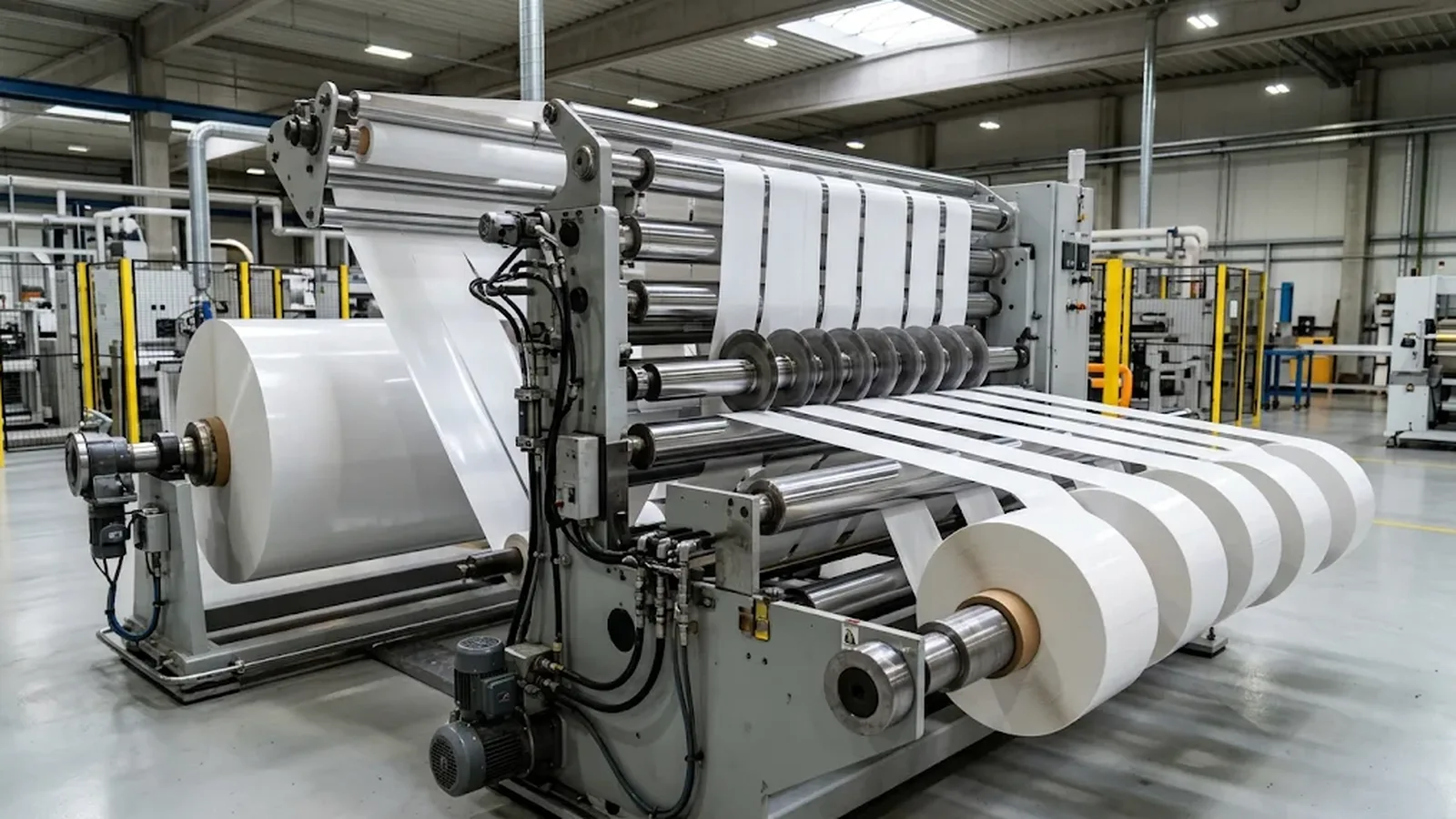
A thermal label roll is direct thermal die-cut label stock wound on a core, and its buying specification is dominated by roll geometry rather than label chemistry: width, core diameter (25.4 mm or 76.2 mm in practice), maximum outer diameter, wound direction (in or out), die-cut pitch and gap, liner type, labels per roll and rolls per carton. Geometry decides whether the roll physically fits and feeds in the dispensing hardware, how many changeovers the operation buys per thousand labels, and how much ocean freight each label consumes — a larger outer diameter packs more labels per roll and fewer changeovers, but fewer rolls per carton and less pallet efficiency. Buyers who specify the full geometry on one sheet, and compare offers on labels per roll and total delivered cost per thousand labels rather than per carton, consistently buy 15-30 percent better than buyers who compare carton prices across mismatched constructions.
Ask for a quotation on direct thermal labels and the first question a serious supplier asks is not what the label says — it is what the roll looks like. Width, core, outer diameter, wound direction, pitch and gap: the geometry of the roll decides whether it fits the hardware, feeds without misalignment, survives the pallet journey and delivers its promised label count. Two quotations for the same label size can differ by thirty percent in delivered value purely on geometry.
Yet roll geometry is the most commonly under-specified part of a label programme. Buyers state the label size and adhesive, then let the supplier choose the rest — and discover the consequences as misfeeds, roll counts that never match the carton promise, and freight invoices that quietly exceed the label cost.
This guide works through the roll as a physical product: the geometry parameters, how each interacts with the dispensing hardware, the labels-per-roll and carton mathematics behind freight economics, how converters produce rolls from jumbo stock, and the specification sheet that keeps replenishment orders arriving right first time. For production volumes, the same construction logic applies to our thermal paper jumbo rolls, quoted per jumbo roll, slit reel or finished format.
- Roll geometry — width, core, outer diameter, winding, pitch and gap — is the core of the label roll specification and decides fit, feed behaviour and freight economics.
- Two cores dominate — 25.4 mm and 76.2 mm — and outer diameter is capped by the dispensing hardware, not preference.
- Labels per roll scales with outer diameter, but rolls per carton falls — total delivered cost per thousand labels is the only comparable number across different geometries.
- Converters slit rolls from jumbo stock, so core, diameter and winding are cheap to customise — treat geometry as negotiable.
- Wound direction must match the hardware — the wrong direction is a guaranteed line stop, and it is invisible until the roll is loaded.
The geometry parameters and their standard values
Width is the first number, and it is governed by the die across the web: a 100 mm label on a 104 mm pitch with liner overhang is specified as a 104 mm roll width. Converters work in width increments of a few millimetres down from their jumbo web width, so a non-standard width is usually one slit from an existing web — cheap, but only if declared before slitting.
Core diameter is next, and in practice the market has standardised on two values. The 25.4 mm (1 inch) core serves compact desktop dispensers and mobile equipment, where the spindle and cavity are small; the 76.2 mm (3 inch) core serves industrial and high-volume lines, where it improves winding stability at speed. Adapters exist, but the core should still be declared: it changes labels per roll and carton packing at once.
Outer diameter is the parameter buyers most often get wrong. It is not a free choice: the dispensing hardware declares a maximum OD, and exceeding it means rolls that do not fit the spindle housing or drag on the cavity walls. Inside the ceiling, larger OD packs more labels per roll — a 180 mm roll on a 3 inch core holds roughly twice the labels of a 127 mm roll of the same width. The buyer's job is to set OD at the hardware's maximum, not at the supplier's default.
Wound direction — labels facing in or facing out on the core — is the one parameter that is invisible until the roll is loaded, and wrong until the line stops. Desktop dispensers overwhelmingly want wound-in; many industrial heads want wound-out. The direction is set at rewinding and costs nothing to specify, so it belongs on every specification sheet.
| Parameter | Typical options | Why it matters |
|---|---|---|
| Roll width | e.g. 104 mm for a 100 mm label | Must match die across the web |
| Core diameter | 25.4 mm (1 in) / 76.2 mm (3 in) | Spindle fit; winding stability; label count |
| Outer diameter | 100-180 mm, capped by hardware | Labels per roll vs carton fit; freight per label |
| Wound direction | In / out | Must match dispensing hardware; wrong direction stops the line |
| Pitch and gap | Label length + 3-4 mm gap (typical) | Sensor tracking; drift causes skipped feeds |
| Liner | Glassine / kraft / PET | Release behaviour, die-cutting quality, waste handling |
| Labels per roll | Derived: OD, core, thickness, pitch | The unit buyers consume |
| Rolls per carton | Derived: geometry + packing spec | Freight and replenishment cadence |
How geometry interacts with the dispensing hardware
Every roll parameter lands on the same place: the moment the roll is loaded into dispensing equipment. The spindle bore must match the core; the housing must clear the outer diameter; the sensor must track the gap at the declared pitch; the web path must see the face on the correct side. Each mismatch is a different failure — rolls that will not seat, labels that skip or double-feed, a line that stops.
The pitch and gap deserve special attention because they are invisible on the finished roll. Sensors detect the gap between labels — a 3-4 mm clear window through to the liner — and count it to position each label precisely. A one-millimetre drift loses position cumulatively — skipped labels, content off the die edge, double feeds — which is why converters hold die-cut tolerance tightly and the specification declares pitch as a value plus tolerance.
Liner choice rounds out the hardware interaction. Glassine liners dominate desktop and industrial formats; PET liners survive moisture and automated applicators but cost more. Release behaviour is a liner-plus-adhesive system property, and the same facestock can behave differently on each.
Buyers specifying constructions against a mixed hardware fleet can review our top-coated thermal label stock, where coating, liner and construction options are documented per grade.
Labels per roll, cartons and the freight mathematics
The arithmetic to run on every offer is labels per roll: the annulus between core and outer diameter divided by the label pitch. OD drives it steeply, and core choice moves it too. But large OD also reduces rolls per carton and cartons per pallet, because roll diameter wastes carton corners. The comparable number across any two offers is total delivered cost per thousand labels: unit price, labels per roll, rolls per carton, cartons per pallet, freight per pallet.
A worked frame: the same 100 x 150 mm label on a 3 inch core at 127 mm OD versus 180 mm OD roughly doubles labels per roll and halves changeovers per thousand labels, but cuts cartons per pallet layer. Whether the bigger roll wins depends on changeover labour cost versus freight cost — which is why the decision belongs in the specification, not in either side's default.
Carton packing is the last lever: rolls per carton, inner polybags, stacking pattern and pallet wrapping decide how many usable labels arrive per container. Buyers sourcing internationally should require the pallet plan with the quotation, and consolidate it with the packing guidance in our export shipping guide before comparing offers.
How converters produce the rolls — and why geometry is negotiable
Finished label rolls are slit and rewound from jumbo stock: a wide parent roll of die-cut label stock is loaded onto a slitter-rewinder, cut across the web into lanes, and each lane is rewound to the specified core, diameter and winding direction while sensors count labels and detect splices. Modern lines inspect continuously and flag imperfect sections automatically.
The consequence for buyers is leverage: core, outer diameter and winding direction are rewinding parameters, not product properties. Within the converting window of its jumbo webs and die layouts, a supplier can move a programme from 1 inch to 3 inch cores, adjust OD and winding direction at negligible marginal cost. What is genuinely fixed is the die (pitch and label shape), which carries tooling cost and lead time. Buyers who treat geometry as negotiable and state it on the specification sheet capture the freight and changeover savings; buyers who accept catalogue defaults subsidise the supplier's converting convenience.
Where a programme needs several formats from one supplier, our custom thermal paper programme covers width, core, roll diameter and construction class in a single specification sheet.
The specification and QC discipline
The discipline that keeps replenishment orders right first time is to declare every geometry line with a tolerance and verify it on arrival. Pitch within ±0.2 mm; outer diameter at or under the hardware ceiling with a stated value; labels per roll stated with the counting method; splice policy declared (marked, and how many per roll are acceptable). Rolls should be sampled on arrival for squareness, diameter, splice marks and label count against the carton declaration.
The failure modes the discipline prevents are the expensive ones: a roll that fits nothing, a pitch that drifts, a count that short-delivers by ten percent, moisture-blistered facestock from unprotected carton storage. None of them is visible from the carton label — all of them are visible in the first hour of a well-run incoming check.

Rule of thumb: the label is a product, the roll is a system — specify it, or it will stop your line.
Frequently asked questions
What core sizes do thermal label rolls use?
Two standards dominate: the 25.4 mm (1 inch) core for compact desktop dispensers and mobile equipment, and the 76.2 mm (3 inch) core for industrial print-and-apply lines and high-volume dispensers. Some hardware accepts both via adapters, but the core should still be declared, since it changes labels per roll and carton packing.
What does wound-in versus wound-out mean?
It is the direction the label face points on the core: wound-in means the printable face is inside the roll; wound-out means it faces outward. The correct direction depends on the dispensing hardware, and the wrong one stops the line — it costs nothing to specify at rewinding, so it belongs on every specification sheet.
How many labels are on a roll?
Labels per roll equals the annulus between core and outer diameter divided by the label pitch. For example, doubling the outer diameter roughly doubles the count at the same width. Always ask for the declared count and the counting method — and compare offers on total delivered cost per thousand labels, not per carton.
Why does the die-cut pitch matter so much?
Dispensing sensors track the gap between labels to position each one. A pitch that drifts even a millimetre from the hardware's expectation causes cumulative misposition: skipped labels, content running off the die edge, double feeds. Declare pitch as a value plus tolerance, typically ±0.2 mm.
Can roll geometry be customised without changing the label?
Yes — core diameter, outer diameter and winding direction are rewinding parameters, adjustable at negligible cost within the converter's window. The genuinely fixed item is the die (label shape and pitch), which carries tooling cost. Treat geometry as negotiable and put it on the specification sheet.