
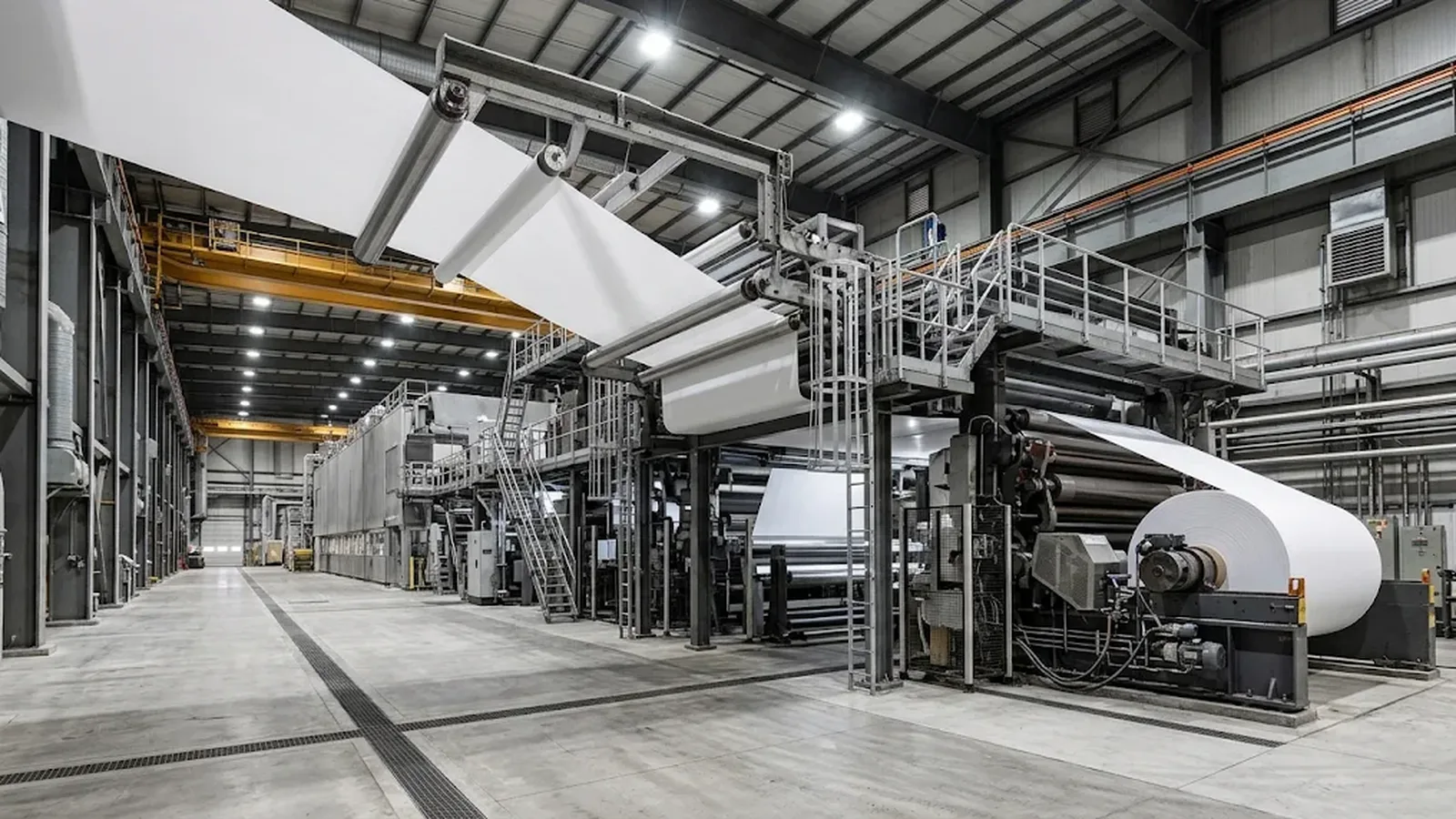
A thermal paper production line is a sequence of stations that turns wide base paper into palletised, documented finished rolls: base paper intake and conditioning, surface preparation, the coating and calendering stage where the sensitive chemistry is applied and finished, slitting and rewinding into jumbo or finished roll formats, and finally packing, palletising and batch documentation with QC test results attached to every lot. What distinguishes a capable line is not any single machine but the control points between stations — coat-weight measurement feeding forward to slitting, moisture control protecting image stability, and traceability that ties each finished pallet back to the base paper batch and coating run. Buyers evaluating suppliers should walk the line (physically or by documented video audit) and check exactly those handoffs, because that is where consistency is either built or lost.
Every thermal roll a retailer loads into a terminal began life as a web of white paper several metres wide, moving through a chain of machines at industrial speed. Between that web and the pallet that leaves the factory gate lies the production line — and the differences between suppliers are written into how that line is laid out, controlled and documented.
Most buyer conversations stop at the datasheet: GSM, width, sensitivity class. But two factories quoting the same datasheet can sit on very different lines — one with in-house coating and in-line measurement, one buying coated jumbos and only slitting. This guide tours a fully integrated production line station by station, so buyers can tell the difference and know what to look for on an audit.
The tour follows the material: intake and preparation, coating and finishing, slitting and rewinding, packing and dispatch. At each station we flag the control point that matters and the question it should raise for a purchasing team.
Our custom thermal paper programme publishes the test data behind each grade, so specifications can be verified against the mill's own measurements rather than a catalogue claim.
- A fully integrated line runs base paper intake → coating → calendering → slitting/rewinding → packing → dispatch, with QC control points between every station.
- In-house coating is the structural difference between a manufacturer and a converter — it decides who can tune the product.
- Coat-weight measurement and moisture conditioning between stations are what make one roll print like the next.
- Slitting and rewinding quality (width tolerance, tension, dust) determines how finished rolls behave in the machine.
- Traceability — pallet back to coating run back to base paper batch — is the audit test of a serious production line.
Station 1 — base paper intake and preparation
The line begins with the input that no thermal manufacturer makes on site: wide rolls of base paper from a pulp mill, specified for basis weight, smoothness and porosity, and delivered in jumbo form. Intake is not a formality — each incoming batch is inspected and conditioned, because base paper variation propagates through everything downstream.
Preparation at this station includes conditioning the paper's moisture content to the mill environment, surface sizing or pre-coating where the grade requires it, and staging rolls for the coater with their batch identities recorded. The control point here is simple: a line that logs base paper batches can trace a field complaint back to its input; a line that cannot, cannot.
Buyer question at this station: which base paper mills do you qualify, and what incoming tests do you run? The answer signals whether the production line starts with control or with hope.
Station 2 — the coating and finishing stage
The heart of the line is the coater, where the liquid sensitive formulation is dispersed, metered onto the moving web at a controlled coat weight, dried through temperature-zoned ovens and calendered to final smoothness. Line speed, viscosity, drying curve and calender pressure interact here, and the grade specification lives in how well those variables are held.
This is also the stage that defines the factory's class. A mill with its own coating line can adjust formulation and coat weight for an application — a heavyweight receipt grade, a cold-chain label construction, a climate-specific backcoat. A factory that buys pre-coated jumbos can only slit and pack. Both are legitimate businesses, but they are not the same business, and quotations should be read accordingly.
The control point leaving this station is measured, not judged: in-line coat-weight scanning and lot sampling for density, sensitivity and background ageing. Records from these tests become the lot documentation that follows the product to the customer.
Capacity planning lives at this stage too. A line's throughput is the product of web width, line speed and uptime, and quoted monthly capacities should be read against grade mix: heavyweight constructions run slower, top-coated grades add a second application pass, and changeovers between chemistries cost time that a busy line recovers through scheduling discipline. Buyers sourcing steady replenishment volumes should ask how capacity is allocated during peak season — a mill that reserves line time for contract customers is a materially different supplier from one that sells residual capacity.
Where a programme needs several formats from one supplier, our 75 gsm heavyweight thermal paper covers width, core, roll diameter and developer class in a single specification sheet.
- Coater: metered application of the sensitive layer at single-digit gsm coat weight.
- Ovens: zoned drying curves that set the film without pre-activating the chemistry.
- Calender stack: pressure and heat bring the surface to its specified smoothness.
- In-line QC: coat-weight scanning plus lot sampling for density and ageing behaviour.
Station 3 — slitting and rewinding
Downstream of coating, wide parent webs are rewound into jumbo rolls for converters or enter the slitting section, where circular knives cut the web into the finished widths the market buys — receipt widths for retail and hospitality terminals, label stock widths for die-cutting converters, ticket and kiosk formats for their own machine classes.
Slitting is where product quality becomes visible to the end user. Width tolerance decides whether a roll feeds cleanly or drags; tension control and core quality decide how the roll winds and unwinds; edge quality and dust management decide whether debris ends up on the coated surface, where it interferes with the image. A well-run slitting section holds tight tolerances at line speed and keeps a dust-control regime that shows in the cleanliness of the finished face.
The control point here is dimensional: width, core size, roll diameter and squareness are measured on sampled rolls per lot. Buyers comparing suppliers should ask what tolerances are held and how they are verified — the answers separate slitters that measure from slitters that assume.
| Station | What happens | Control point | Buyer-visible result |
|---|---|---|---|
| Base paper intake | Batch inspection, conditioning, staging | Incoming QC, batch logging | Traceability, consistency of inputs |
| Coating & finishing | Dispersion, metered coating, drying, calendering | Coat weight tolerance, drying curve | Sensitivity, density, image life |
| Slitting & rewinding | Width slitting, tension-controlled rewinding | Width tolerance, dust control | Clean feeding, sharp edge quality |
| Packing & dispatch | Moisture-barrier packing, palletising, documents | Packing spec, lot documentation | Shelf stability, auditable traceability |
Station 4 — packing, palletising and documentation
Finished rolls leave the slitter at their most vulnerable: dry, smooth, coated surfaces that absorb moisture and scuff easily. The packing station wraps rolls in moisture-barrier materials, boxes them to the agreed count, and palletises with edge protection and stretch or shrink wrap — specification items that matter far more on an ocean crossing than in the factory.
Documentation is the last station before dispatch and the first thing an importer audits at destination. Each pallet carries labels tying it to a production lot; each lot carries the QC record — density, sensitivity, ageing results and the developer chemistry class declared in writing. A production line that closes this loop can answer a complaint with data; one that does not can only offer an apology.
Where container planning is the next step, our export shipping guide covers pallet standards, moisture-barrier packing and the document set for ocean freight.
Audit shortcut: if a line cannot show you lot documentation tying a pallet to its coating run, everything upstream is unverified.
Frequently asked questions
What is the difference between a thermal paper manufacturer and a converter?
A manufacturer runs its own coating line and controls formulation, coat weight and finishing; a converter buys coated jumbo rolls and slits and packs them. Converters add value in formats and service, but only a manufacturer can tune the product itself — a distinction that should shape how quotations are compared.
What coat weights and speeds does a production line run?
Sensitive-layer coatings are typically single-digit gsm applied at industrial line speeds, with topcoat and backcoat added where the grade requires them. The exact figures vary by grade and machine class; what matters for buyers is that coat weight is measured in-line and held to a stated tolerance.
Why is slitting quality so important if the coating is good?
Because the end user experiences the slit roll, not the web. Width tolerance, tension and edge dust decide whether rolls feed cleanly and print sharply. Poor slitting can ruin a well-coated product's reputation in a single consignment.
How should I audit a thermal paper production line?
Walk (or video-audit) the stations in order and check the handoffs: incoming base paper records, in-line coat-weight measurement at the coater, dimensional QC at slitting, and lot documentation at packing. Each control point should produce a record you can be shown.
Can one line produce both receipt rolls and label stock?
Yes — the same coating line produces wide parent webs for both, and the slitting section formats them differently: narrow receipt widths rewound on standard cores, or wider label stock for die-cutting converters. The chemistry and topcoat construction are what differ between the grades.