
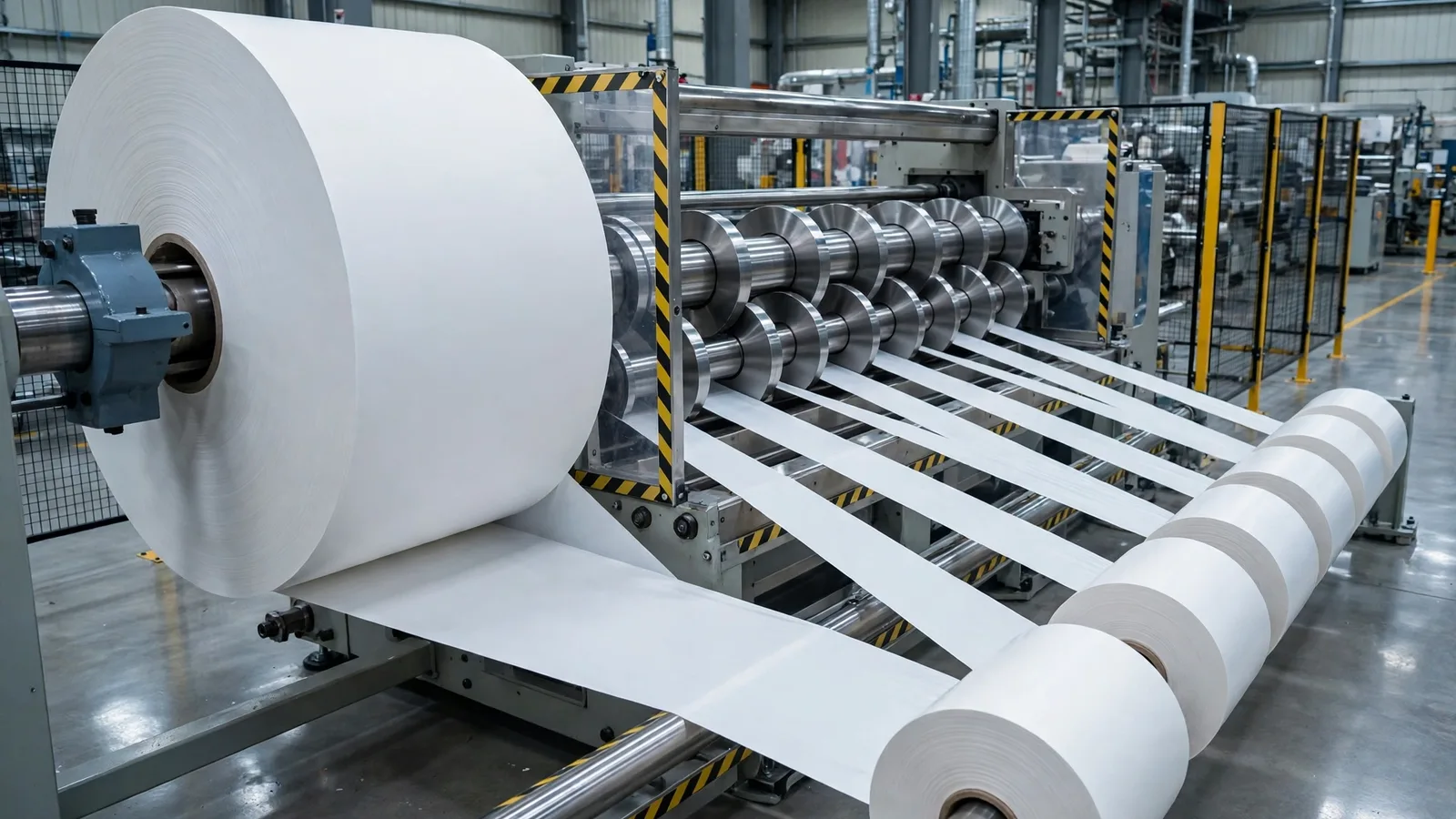
The slitting step decides more of a thermal roll's in-machine behaviour than the base paper does: width tolerance and edge quality determine tracking on the media path, slitter dust determines head contamination over a service life, and winding tension determines curl and core bond. Evaluating a thermal paper slitting factory therefore means looking past the price sheet at four things — the slitter class and blade regime on the line that will cut your order, the width tolerances the factory actually measures (and records) rather than merely claims, the yield and trimming plan that explains the quoted price, and the QC documentation per batch (width checks, dust counts, wound-roll inspection). A factory that publishes measured process data on those four points will outperform a cheaper quote that cannot show them, because every millimetre of tolerance and every gram of dust shows up later as jams, reprints and service calls in the buyer's operation.
Between the jumbo roll that leaves the mill and the finished roll that feeds a point-of-sale device or kiosk sits the slitting line — and the converting step quietly decides how the roll will behave for its entire service life. Width tolerance sets how the paper tracks through the media path; edge quality sets whether the outer turns shed dust onto the head; winding tension sets curl, core bond and how the last metres of the roll feed. A poorly slit roll can ruin an otherwise excellent coating.
Buyers evaluating suppliers tend to compare the paper — GSM, developer class, coating construction — and treat the slitting factory as a fixed step behind it. The better question is whether the converting operation can hold, measure and document the tolerances your equipment fleet actually needs, because two factories converting the same jumbo stock will deliver materially different finished rolls. Buyers comparing these specifications can review our custom thermal paper programme, where basis weight, coating construction and packing are documented per grade before an order is placed.
This guide sets out an evaluation in the order risk actually appears: what the slitting step decides, the equipment and process capability to look for, the yield and freight economics behind the quote, and the QC documentation that tells you whether the tolerances are measured or merely promised.
- Width tolerance, edge quality, dust and winding tension decide in-machine behaviour — evaluate the slitting line, not only the paper.
- Ask which slitter class and blade regime will run your order, and how blade changes and knife maintenance are scheduled.
- Insist on measured tolerances with batch records, not catalogue claims; a tolerance nobody measures is a tolerance nobody holds.
- Understand the yield and trimming plan behind the quote — unexplained low prices usually hide off-spec widths or scrap reinjection.
- Batch QC documentation (width checks, dust, wound-roll inspection, COA linkage) is what turns a supplier into a converting partner.
What the slitting step decides
Width tolerance is the first and least forgiving output. A roll specified at 80.0 mm and slit at 80.6 mm may load fine by hand and still mis-track in a mechanism with a fixed media guide, shedding the image off one edge or dragging the paper against the frame. Different device fleets tolerate different slop — which is why a converting partner should quote a tolerance per width and hold it, rather than quoting '±0.5 mm' generically and letting the distribution curve decide.
Edge quality is the quieter variable. Slitting shears or scores the edge, and a worn blade or wrong blade pressure leaves micro-burrs and loosened fibres at the edge. Those fibres become dust — the dust that accumulates on thermal heads and platen rollers over the roll's life, degrading print density and forcing service calls long before the paper itself has done anything wrong. Dust performance is where converting quality shows up months later in the buyer's maintenance statistics.
Winding tension completes the picture. Too loose and the roll telescopes and the outer turns handle roughly; too tight and the paper takes a set that shows up as curl and as feed problems in the last fifth of the roll. Tension profile along the winding cycle is a process parameter a serious factory controls and records — and one a spreadsheet quote never mentions.
Equipment and process capability to look for
Slitter class matters. Precision slitting lines with automatic knife positioning, tension control across the web and inline inspection hold tolerances that older lines can only aspire to on their best day. The evaluation question is concrete: which line will run my order, what is its measured width tolerance at my widths, and how are blades specified and changed? A factory that answers those three questions with numbers is a different supplier from one that answers with a brochure.
Blade regime is the follow-up. Shear-cut and score-cut behave differently on coated thermal stock, and blade change intervals decide whether roll number one and roll number eight thousand leave the line with the same edge. Ask how knife maintenance is scheduled — by metres run, by shift, by operator judgement — because 'by operator judgement' is where dust problems are born.
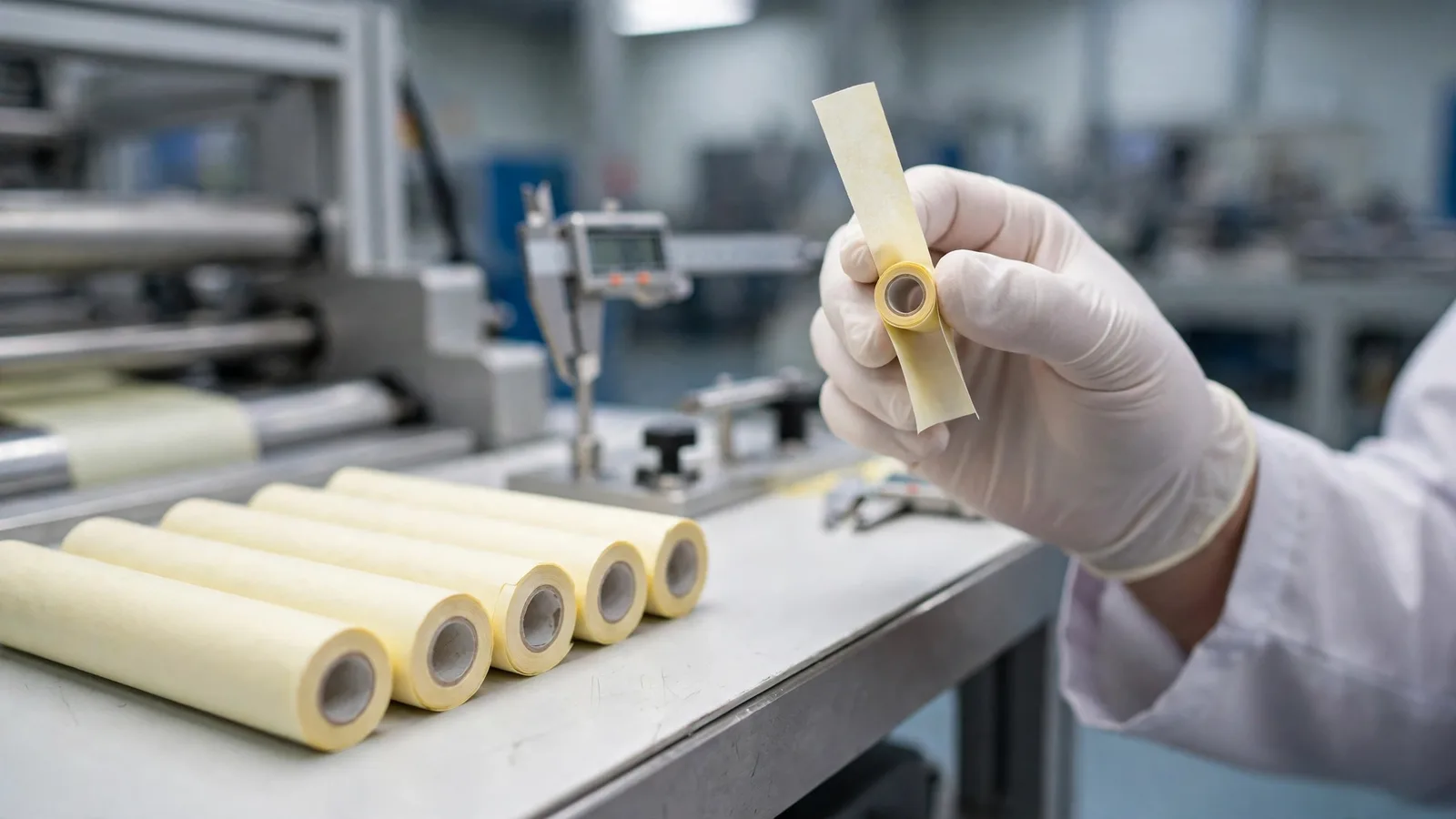
Inspection capability closes the equipment story. Wound rolls should be inspected for splice discipline, telescoping, core damage and face quality before packing, and the factory should be able to show what happens to a rejected roll — because scrap that re-enters the flow unmarked is how off-spec stock reaches customers. Where a programme needs several formats from one supplier, our POS and receipt paper rolls range runs from 57 mm terminals to 80 mm retail widths on the same documented tolerance regime.
Yield, trimming plan and freight economics
Every slitting plan has a yield: the fraction of the jumbo roll that becomes sellable finished product after trim, setup and edge loss. The yield explains the price. A quote materially below competing bids usually reflects one of three things — a wider trim allowance converted into narrower finished widths, off-spec rolls sold into the order, or thinner parent stock than specified. Asking for the slitting plan behind the quote (parent width, slit count, trim disposition) separates genuine converting efficiency from hidden degradation.
For heavyweight constructions the yield question interacts with the grade itself: thicker stock means fewer metres per parent roll and more changeover waste per tonne, which is why heavyweight converting quotes need the same scrutiny as lightweight ones. Our 75 gsm heavyweight thermal paper is slit with the trim plan documented per order, so the yield behind the quote is visible rather than assumed.
Freight rides on the same arithmetic. Finished rolls pack to a pallet pattern, and the converting step decides how well the programme fills a container — roll diameter, packing format and carton count per pallet are all settled at the slitting plan stage. Buyers planning ocean freight should have the pallet pattern quoted alongside the price, not discovered at the first booking.
QC documentation and acceptance testing
The line between a supplier and a converting partner is documentation. Per batch: width measurements at defined sampling intervals, dust and edge-quality checks, wound-roll inspection results, and a COA linking the finished rolls back to the parent stock batch — because converting traceability is only real if it reaches the mill's own records. The document set should be quotable in the supply agreement, with a defined turnaround, not promised as available on request.
Acceptance testing then closes the loop on the buyer's side. Sample finished rolls from each batch, load them into the devices that will actually consume them, and check the three behaviours the slitting step decides: tracking through the media path, edge dust after a period of high-volume running, and feed behaviour at the end of the roll. A first-article discipline at order start, plus periodic batch sampling, keeps the tolerances honest for the life of the programme.
For programmes specifying coating construction as part of the order, the QC conversation extends to the coating class itself. Where image life is the deciding factor, our top-coated vs non top-coated guide compares the two constructions on retention, cost and machine behaviour — the same acceptance criteria a converting partner should be able to test against before the rolls ship.
Frequently asked questions
What width tolerance should a thermal paper slitting factory hold?
It depends on the device fleet, but the evaluation point is that the tolerance is quoted per width, measured, and recorded per batch — not quoted generically. Mechanisms with fixed media guides punish loose tolerances with mis-tracking, edge drag and jams.
Why does slitting affect thermal head dust?
A worn blade or wrong blade pressure leaves micro-burrs and loosened fibres at the roll edge. Those fibres shed as dust during the roll's life and accumulate on thermal heads and platen rollers, degrading print density and triggering service calls. Blade regime and change intervals are therefore maintenance-cost questions, not just converting details.
Why is one slitting quote much cheaper than the others?
Usually one of three things hides behind the price: wider trim converted into narrower finished widths, off-spec rolls sold into the order, or thinner parent stock than specified. Ask for the slitting plan — parent width, slit count, trim disposition — behind any materially low quote.
What QC documents should a slitting factory provide per batch?
Width measurements at defined sampling intervals, dust and edge-quality checks, wound-roll inspection results, and a COA linking finished rolls to the parent stock batch. The document set should be written into the supply agreement with a defined turnaround.
How should buyers acceptance-test finished rolls?
Sample rolls from each batch and run them in the devices that will consume them, checking media-path tracking, edge dust after high-volume running, and feed behaviour at the end of the roll. First-article testing at order start plus periodic batch sampling keeps tolerances honest.