
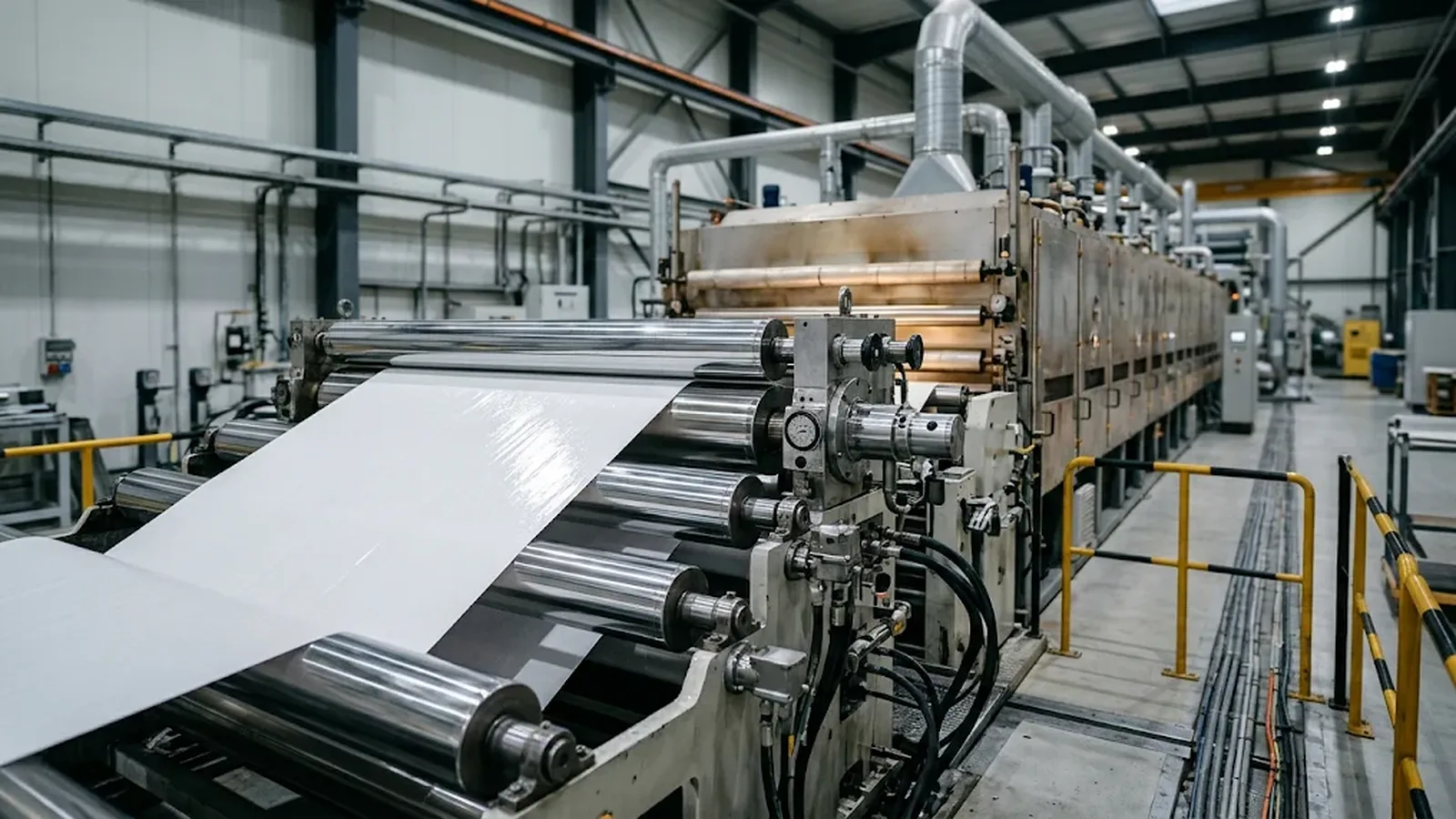
The thermal paper coating process runs in four controlled stages: the sensitive formulation is first dispersed into a stable liquid (leuco dye, developer, sensitiser, binder and pigments ground to a defined particle size in water); it is then applied onto the moving base paper by a metering coater that sets film thickness in single-digit grams per square metre; the wet coating is dried through temperature-zoned ovens and calendered to final smoothness; and coat weight, density and ageing behaviour are measured continuously or per lot to hold tolerance. Because a deviation of fractions of a gram per square metre shifts print density, sensitivity and image life measurably, the process — not just the formulation — is what separates a consistent mill grade from an inconsistent one. Buyers should treat coat-weight tolerance and in-line measurement capability as core supplier qualifications, equal in importance to the chemistry itself.
Ask most thermal paper quotations what coating they carry and you will get an adjective — 'top-coated', 'premium', 'long-life'. Ask what process applied that coating and you will usually get silence. Yet the same formulation can produce two very different products depending on how it was dispersed, applied, dried and calendered. The coating process is where chemistry becomes a repeatable product.
This guide walks the process end to end: what happens in the dispersion stage, how the coater meters the film onto the web, what the ovens and calender stack actually do, and how coat weight and sensitivity are kept within tolerance across a production run. It is the process-engineering companion to our chemistry-focused coating layers article — here the subject is the machinery and the control loop, not the molecules.
The reason this matters commercially is simple: coat weights are specified in single-digit grams per square metre, and print behaviour shifts measurably inside that range. A supplier that cannot hold process tolerance cannot hold product consistency, whatever the datasheet says.
Buyers comparing these specifications can review our top-coated thermal label stock, where basis weight, coating construction and packing are documented per grade before an order is placed.
- The coating process has four stages: dispersion, metered application, drying and calendering, followed by measurement and control.
- Dispersion quality — particle size and stability of the liquid formulation — decides print uniformity before the web is even coated.
- Coat weight is set mechanically by the metering coater and specified in single-digit gsm; tolerance is the single most important process parameter.
- Drying curves and calendering pressure set smoothness, sensitivity and background behaviour; rushing either shows up as defects.
- Serious manufacturers measure coat weight in-line and publish lot-level QC data; spot-checking finished rolls is a weaker control.
Stage 1 — formulation and dispersion
The coating starts as a liquid, and its quality is fixed before the paper ever enters the machine. The functional ingredients — leuco dye, developer, sensitiser, binder and fine mineral pigments — arrive as powders and liquids that must be dispersed in water into a stable, uniform suspension. That means controlled wetting, milling or grinding to a defined particle-size distribution, and chemical stabilisation so the solids do not agglomerate, settle or destabilise over the run.
Dispersion quality is monitored with measurable parameters, not by eye: solids content, viscosity at defined shear rates, pH, and particle-size distribution on the mill. A coarse or unstable dispersion prints unevenly across the web and drifts between batches, because large particles and flocs coat differently from a fine, uniform suspension. This is why mills that formulate in-house guard dispersion recipes and milling times as closely as the ingredient list itself.
For buyers auditing a supplier, the dispersion stage is a good interview question: who prepares the formulation, on what milling equipment, and what particle-size and viscosity windows are released to the coating line? A mill with a real answer has a process; a trader has a brochure.
Stage 2 — metered application onto the web
Application is where the process earns its precision. The base paper — itself usually pre-coated on the reverse and surface-sized — runs through the coater at line speed, and the liquid formulation is deposited and metered down to a target film thickness. Depending on the line and grade, this is done with metering rod, blade or curtain-type applicators; what they share is that the excess is scraped or metered off, so the applied weight is controlled mechanically rather than left to soak-in.
The target is expressed as coat weight in grams per square metre, and the numbers are small: the sensitive layer is typically a single-digit gsm coating, and optional topcoat and backcoat each add roughly one to two gsm. Against those magnitudes, machine-level control matters enormously — a fraction of a gram per square metre of drift changes activation energy, print density and the behaviour of every roll slit downstream from that section of the web.
This is also where the difference between coating in-house and buying pre-coated paper becomes structural. A manufacturer running its own coater can tune coat weight, drying profile and surface finish for a specific application — a cold-chain label that needs a heavier barrier topcoat, or a lightweight receipt grade where every gram of coating must earn its cost.
For production volumes, the same construction logic applies to our thermal paper jumbo rolls, quoted per jumbo roll, slit reel or finished format.
- Metering rod / blade / curtain applicators — deposit and meter the wet film to target thickness.
- Coat weight target — single-digit gsm for the sensitive layer; ±tolerance is the key specification.
- Line speed — interacts with viscosity and drying; a stable recipe holds sensitivity across the speed range.
- Two-sided control — backcoat is applied and balanced against the coated face to manage curl.
Stage 3 — drying and calendering
A freshly coated web is wet, and how it is dried decides the final film. Drying runs through temperature-zoned ovens on a defined curve: hot enough to remove water and set the binder film, gentle enough not to pre-activate the dye system or drive the chemistry into premature reaction. The drying profile is part of the product specification — the same formulation dried on two different curves can differ in background stability and sensitivity.
Calendering follows: the dried web passes through hard and resilient rolls under pressure and, sometimes, heat, which consolidates the coating and brings the surface to its final smoothness. Smoothness is not cosmetic — the closer the coated surface, the better the contact with the print head and the sharper the developed image. Calender settings therefore trade smoothness against density and cost, and are tuned per grade.
After calendering, the finished parent web is rewound into jumbo rolls with their moisture re-equilibrated and their edges trimmed. From here the material either ships to converters as jumbo stock or enters the mill's own slitting lines — but everything the finished rolls will do was already decided on the coating machine.
Stage 4 — measurement: in-line control and laboratory QC
A process is only as good as its measurement loop. On modern coating lines, coat weight is measured continuously across the web — with scanning gauges — so drift is corrected at the machine rather than discovered in the warehouse. In-line measurement converts coat-weight tolerance from a claim into a controlled variable, and the records it produces become the lot documentation buyers can audit.
Laboratory QC completes the loop on finished material: print density and sensitivity against reference conditions, background ageing (how fast unprinted areas darken under elevated temperature and humidity), accelerated image retention, and rub, water and oil resistance for top-coated grades. These are the same numbers a buyer should demand in a specification — because they are the readout of the whole process.
The practical hierarchy for evaluating suppliers: in-line coat-weight measurement plus lot-level lab reports is the strongest signal; end-of-line sampling only is weaker; 'controlled by experienced operators' is not a control at all. The precision of the measurement system is a direct proxy for the precision of the product.
Where image life is the deciding factor, our top-coated vs non top-coated guide compares the two constructions on retention, cost and machine behaviour.
| Stage | What happens | Key controlled parameter | Buyer-visible result |
|---|---|---|---|
| Dispersion | Dye, developer, sensitiser, binder and pigments milled into a stable liquid | Particle size, viscosity, solids, pH | Print uniformity, batch-to-batch consistency |
| Application | Liquid metered onto the moving web | Coat weight (gsm) and tolerance | Sensitivity, density, cost per square metre |
| Drying & calendering | Temperature-zoned drying, then roll consolidation | Drying curve, calender pressure/temperature | Smoothness, sharpness, background stability |
| Measurement | In-line gauges plus laboratory testing per lot | Coat weight scan, density, ageing tests | Auditable QC data behind the specification |
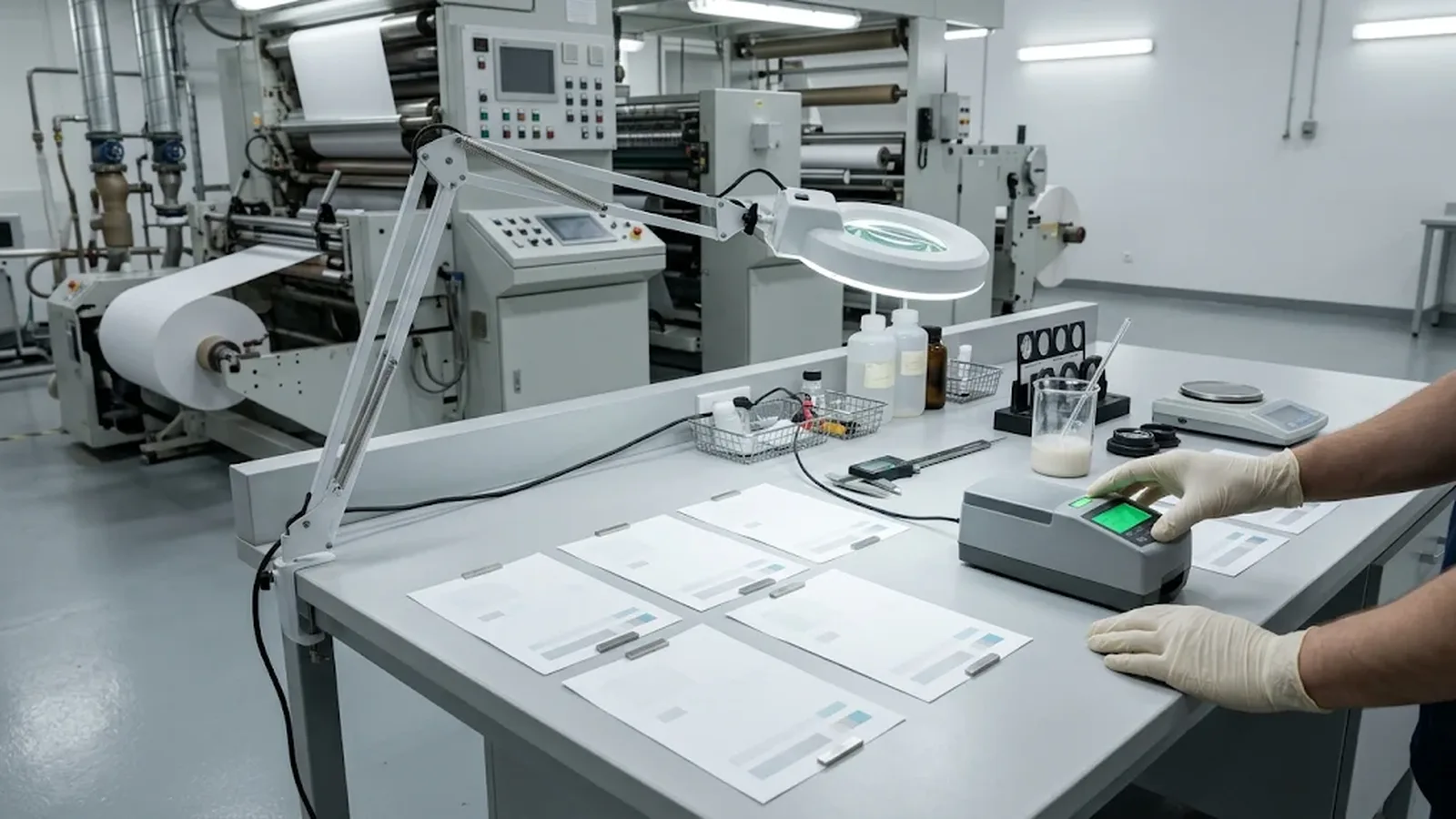
Rule of thumb: a coating process you cannot be shown measurements from is a process you cannot rely on.
Frequently asked questions
What coat weight does thermal paper carry?
The sensitive layer is typically a single-digit gsm coating; optional topcoat and backcoat each add roughly 1–2 gsm. The exact figures and the tolerance held around them are the process specification — serious suppliers state both and can show measurement records.
Why does the dispersion stage matter if the recipe is the same?
Because the same ingredients dispersed poorly — coarse particles, instability, drift in viscosity — coat unevenly and age inconsistently. Dispersion quality decides print uniformity across the web and between batches, which is why mills control particle size and viscosity with the same rigour as the formula.
Is in-line coat weight measurement really necessary?
It is the difference between controlling drift and discovering it. Coatings are so thin that small deviations shift print density and sensitivity measurably; continuous scanning across the web catches drift at the machine, while spot checks on finished rolls only report it after the fact.
Does the drying profile affect image quality?
Yes. Drying too aggressively can pre-activate the chemistry and raise background fog; drying too little leaves an unset film with poor rub resistance. The drying curve is part of the grade specification and is tuned alongside calender settings.
What should I ask a supplier about their coating process?
Whether coating is in-house, what coat weights and tolerances they run, whether coat weight is measured in-line, and what lot-level laboratory data accompanies shipments — density, sensitivity and accelerated ageing results. Concrete numbers and named methods are the strongest supplier signal.