
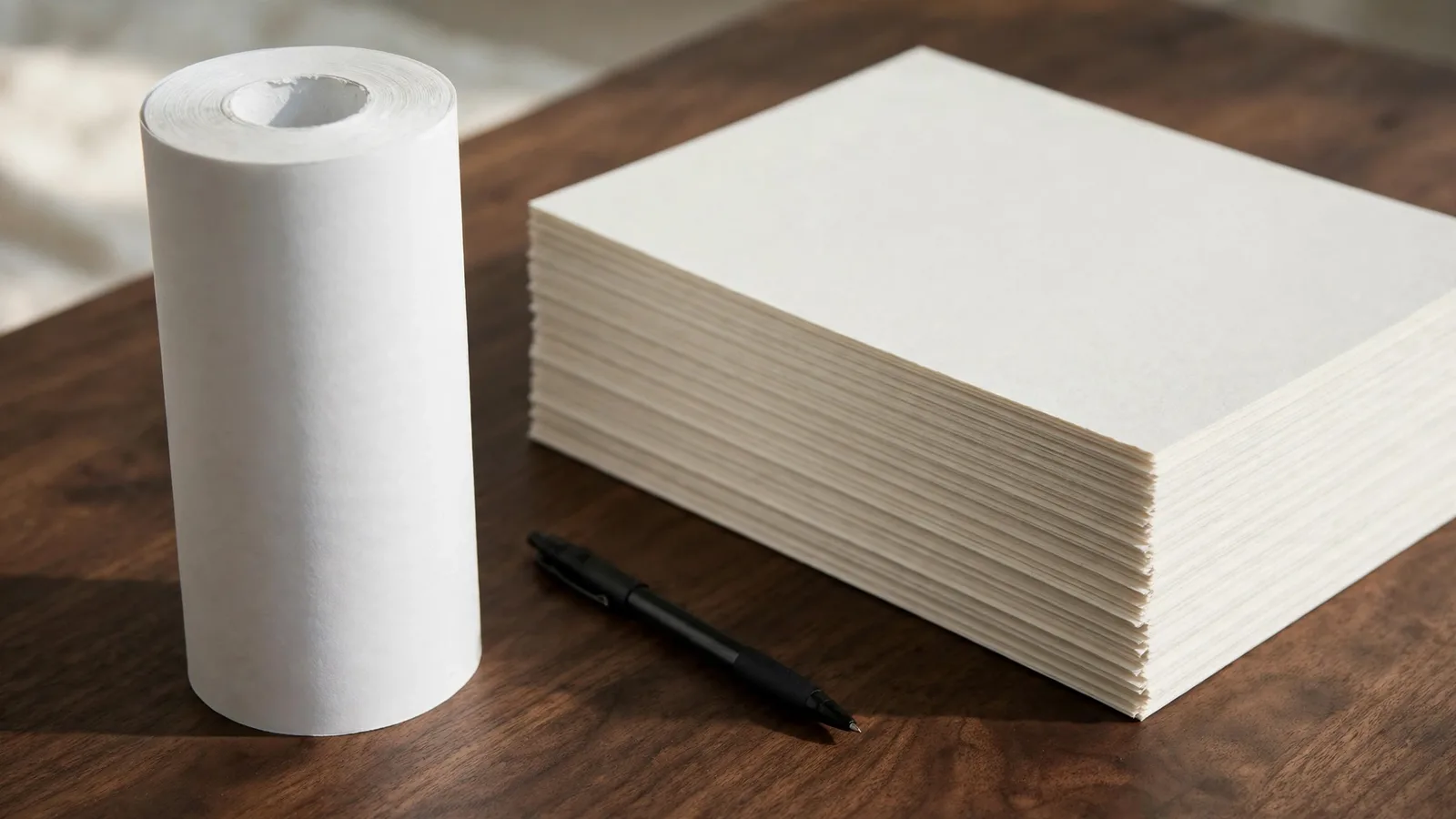
Thermal paper carries a heat-sensitive coating and prints through heat alone, with no ink or ribbon in the consumable set; bond paper is uncoated woodfree stock that needs an ink ribbon or similar transfer system to carry an image. Thermal wins on consumable simplicity, print speed and compact device design, at the cost of heat- and contact-sensitive image life. Bond survives heat, light and plastic contact better and supports cheap multi-ply carbonless duplicates, but it drags an ink consumable and slower mechanical printing into the programme. The right answer is per application: transaction receipts skew thermal, duplicate-carbon records and harsh-environment documents keep a case for bond or carbonless.
Almost every buyer inherits a media decision rather than making one. The estate already has receipt devices designed around direct thermal rolls, so thermal paper arrives as the default — while bond paper survives in the background as the paper of invoice pads, log books and duplicate forms. When a new programme, a new market or a new device generation forces the question, the comparison deserves to be made deliberately, because the two media differ in mechanics, cost structure and image life in ways that landing costs do not reveal.
The technical split is simple to state. Bond paper is plain, uncoated woodfree stock: nothing on the sheet reacts, so an image must be brought to it — historically by an impact mechanism striking a fabric ink ribbon, today more often by separate office equipment. Thermal paper is base paper plus a coating containing dye and developer chemistry; heat from a print head develops the image inside the coating itself. One medium stores its ink inside the paper, the other imports it from a consumable.
For converters and distributors, the comparison also runs upstream: both media start as parent stock, and our thermal paper jumbo rolls are quoted per jumbo roll, slit reel or finished format for operations that cut their own receipt widths from either lane.
This guide compares the two media the way a procurement team should: print mechanics, the true cost structure, image life and storage, the carbonless exception, and an application-by-application decision framework.
- Thermal paper prints by heat developing a coating; bond paper needs an external ink system — the consumable set, not the media price, is where the programmes diverge most.
- Direct thermal enables compact, fast, low-mechanism devices: fewer moving parts, no ribbon changes, quieter operation at transaction speed.
- Thermal images are vulnerable to heat, plasticisers, solvents and abrasion; bond and carbonless documents tolerate harsher storage, which keeps them alive for records that must survive years of abuse.
- Multi-ply carbonless remains the practical answer where duplicate copies must be created at the moment of writing — no thermal programme replicates that without a second print pass.
- The decision is per application, not per company: most estates run both media, matched to transaction speed, duplicate requirements and document life.
Two media, two print mechanics
Bond paper is defined by what it lacks: a coating. The sheet is sized woodfree stock, smooth enough to accept ink but chemically inert, so every image is imported — by an impact mechanism striking a fabric ink ribbon against the sheet, by a dot-matrix head, or by separate equipment entirely. The media itself is commodity paper, priced close to ordinary writing grades, but the programme inherits whatever mechanism carries the ink.
Thermal paper reverses the architecture. The coating holds both the dye and the developer; the print head supplies nothing but heat at the right places. That removes the ink consumable entirely, and with it the ribbon stock, the ribbon-change maintenance and the striking mechanism. Devices built around direct thermal are correspondingly simpler, faster and quieter, which is why transaction printing at counters and terminals consolidated on thermal decades ago.
The mechanical difference propagates into fleet economics. A thermal estate's consumable line is one media; a bond estate's is two — paper plus ink — and the ink line has its own shelf life, storage conditions and change-out labour that never appears in a media price comparison.
Cost structure: media price is not programme cost
Per tonne, bond paper usually quotes lower than thermal stock — the coating package is real value added. But the honest comparison is cost per printed document, and there the picture inverts: thermal's single consumable and high print speed drive low cost per receipt, while a bond programme adds ribbon consumption, slower output and mechanism wear per document. Buyers who compare invoice price per kilogram alone systematically overrate bond.
Volume and format sharpen the arithmetic. At transaction scale — thousands of short receipts per site per day — thermal's speed and media simplicity compound into visibly lower operating cost, which is why high-volume retail, hospitality and queue environments abandoned bond long ago. At low volume and long document length, the gap narrows, and document longevity starts to weigh the other way.
For programmes buying by weight, the grammage lever works on both media, and lightweight constructions change the per-document maths; our 48 gsm lightweight thermal paper documents the lightweight class where meters per roll and cost per receipt matter most.
Image life, storage and the durability trade
Bond's greatest advantage is indifference. An ink image on plain paper shrugs at heat, sunlight, plastic sleeves and most solvents that would destroy a thermal print, and it asks nothing of storage discipline beyond ordinary filing. Thermal images, by contrast, live inside a chemical system that heat, plasticisers, adhesive contact and abrasion can reverse — image life is a specified property of the grade, not a given.
That trade is manageable rather than fatal. Sensitivity class and coating construction set the retention profile: low-sensitivity, long-life grades and protected top-coated constructions hold legible barcodes and text for years under reasonable archiving discipline, and the storage rules — cool, dark, dry, away from plastic and fresh carbonless — are cheap to follow once documented.
Where documents must survive genuinely hostile conditions — engine rooms, outdoor queues, wallets for years — the comparison should be run on the specific grades in play rather than on category averages, because a well-specified thermal grade can outperform an ill-specified bond programme whose ink fades or whose carbonless chemistry degrades in the same drawer.
The carbonless exception: where duplicates decide
One bond-family capability has no thermal equivalent at the point of use: instantaneous duplicates. Multi-ply carbonless stock creates a copy on the second and third ply at the moment of writing, with no device involved — which is why delivery notes, service dockets and field order books remain carbonless territory wherever a signed customer copy must exist before the device prints anything.
Thermal programmes replicate duplicates only by printing twice — two passes, two rolls, two handling steps — or by printing on pre-printed carbonless-like constructions, both of which add cost and process. Where the duplicate requirement is structural rather than occasional, bond-family media keeps the operational advantage regardless of how good the thermal programme is.
Applications that only need an archival copy, however, are served better by a long-life thermal grade: the second copy prints identically to the first, stores flatter, and needs no multi-ply pad logistics. The duplicate question — moment-of-writing versus after-the-fact — cleanly separates the two camps.
Choosing by application, and the paperwork behind the thermal side
The decision framework the comparison supports is short. Transaction receipts, terminal slips, queue and event tickets, logistics labels and high-volume counter printing belong to thermal: speed, consumable simplicity and compact devices dominate. Duplicate-at-source field documents and records filed in genuinely hostile storage keep a case for bond and carbonless. Most estates run both, and the procurement task is keeping each lane on a documented specification rather than letting habit decide.
On the thermal side, the specification carries one obligation bond never faces: the developer system. Because the imaging chemistry is part of the paper, buyers into regulated retail channels need the developer class declared and documented — and where developer compliance is part of the specification, our BPA-free vs phenol-free guide documents the chemistry, the regulations and the paperwork behind each class.
Label logistics tilt the comparison decisively toward thermal, because adhesives and die-cut formats pair naturally with coated facestocks; our top-coated thermal label stock covers the labelside construction where bond has no comparable offering at all. Where a programme needs several formats from one supplier, the specification sheet — width, core, diameter, developer class — is the document that keeps both lanes honest.
Frequently asked questions
Is bond paper cheaper than thermal paper?
Per tonne, usually yes — it is uncoated commodity stock. Per printed document, usually no: bond programmes carry an additional ink consumable, slower print output and more mechanism wear, while thermal's single-media cost structure is what made it the transaction-printing standard. Compare cost per document, not price per kilogram.
Can bond paper be used in receipt devices?
Only in devices built for impact or ribbon-based printing. Direct thermal mechanisms develop an image inside the coating and cannot mark plain paper at all — a bond roll loaded into a thermal unit feeds normally and prints nothing. The media and the mechanism must be matched.
Which medium lasts longer?
Bond tolerates hostile storage better by default, because an ink image on plain paper has no chemical vulnerability to heat, plastic or light. Thermal retention is a specified property: low-sensitivity and top-coated grades achieve multi-year legibility under documented storage conditions, but the grade choice drives the outcome.
Why do duplicate forms still use carbonless paper?
Because carbonless creates the copy at the moment of writing without any device, anywhere. Thermal duplicates require a second print pass, which is not always possible or appropriate in field and delivery workflows where the customer signs the original copy.
Is thermal paper safe for customer-facing receipts?
Yes, when the developer class is specified and documented. Regulated retail channels increasingly require BPA-free or phenol-free developer systems, and the supplier's SDS and compliance documentation — not the media comparison — is where that assurance lives.